
It popped up again, this time in one of the post-onboarding surveys I send new employees after they’ve had some time to review the training I’ve assigned them.
I am a practical learner. The videos were a good starting point, but I would want more hands on training.
My reaction can be summed up in that rather rude phrase that calls the other person Sherlock.
Well, of course, you’d want more hands-on training. That’s how people (all people) learn things — through DOING. This isn’t some “learning style” difference. It’s called being human.
If you sit in a training session, deli sandwich in hand, and watch someone demonstrate something, you’re just being exposed to how something is done. But until you’ve actually tried to replicate those steps in a real-life example, you haven’t actually learned anything.
Okay, that’s not exactly true. Once you’ve been exposed to “how to do ‘X’,” you’ve at least remembered a few facts and (one would hope) understood something you didn’t before. Applying that, however, is literally a whole new level, and that is true learning.
This phenomenon is explained by something called Bloom’s Taxonomy. When you learn anything, you go through a predictable series of steps:
- Remember. Recall facts and basic concepts. Related verbs: define, duplicate, list, memorize, repeat. Entirely passive.
- Understand. Explain ideas or concepts. Related verbs: classify, describe, discuss, explain, identify, report, select, translate. Mostly passive.
- Apply. Use information in new situations. Related verbs: execute, implement, solve, use, demonstrate, interpret, schedule, sketch. Active – where actually learning truly begins.
- Analyze. Draw connections among ideas. Related verbs: differentiate, organize, relate, compare, contrast, distinguish, experiment, question, test. Where you start to stand out from others.
- Evaluate. Justify a stand or decision. Related verbs: appraise, argue, defend, judge, select, support, value, critique. Where you start thinking like an expert.
- Create. Produce new or original work. Related verbs: Design, assemble, construct, conjecture, develop, formulate, author. THIS is true mastery.
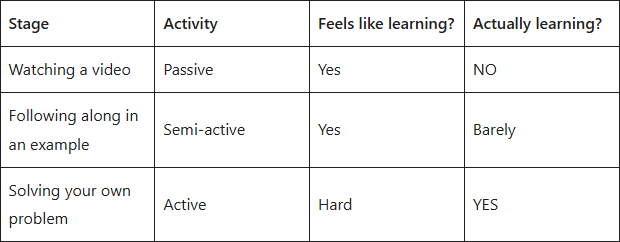
And this is how this applies to the scenario my survey respondent was in:
(And, yes, this theory has its critics.)
Watching the videos, she could remember new things and possibly understand them, but until she took the next step and attempted to apply what she understood, she wasn’t going to truly learn anything.
I’ve been studying Python (a programming language that’s ideally suited to beginners) for a while now. Python learners have a phrase: “tutorial hell”. That describes where a lot of Python learners are stuck: They watch video after video, enroll in course after course, and still can’t solve a real-life problem with Python.
The advice that a lot of Python instructors give is, find a coding project you truly care about and struggle through it. The struggle is where genuine learning takes place, even (especially) if it feels like you’re just not getting it.
It’s well-documented in the scientific literature that effective learning always feels harder, while the activities most favor (watching videos, reviewing things repeatedly, highlighting reading passages) are all but useless.
Effective learning always feels harder.
I’ve been trying to implement that strategy in my own Python learning, by getting ChatGPT (the world’s most patient and effusively encouraging tutor) to give me coding prompts and problems to solve, then feeding my answers back to ChatGPT to critique. It’s been a frustrating experience, but I’m gaining fluency and reconfiguring my thought processes in a way I hadn’t before.
So, what does this have to do with this site and the courses I offer?
Recently, I had the opportunity to get hands-on with a new learning management system. One of the coolest features I saw was what this vendor calls “Skill Checks.” They’re basically click-along tutorials. The narrator instructs you to click the correct menu to do ‘X’; you click somewhere, and the pop-up tells you whether you clicked in the right place. In quiz mode, the software records your answer and tallies your score for the full evaluation.
This isn’t new. I remember going through one of these years ago when I was applying for jobs through an employment agency. Interactive quizzing itself is not new.
But the technology for producing these is becoming more accessible and affordable. It’s a whole other level of teaching, and it’s available to anyone with a computer and a willingness to dig in and learn the software.
It’s one thing to write down the steps to doing something. Still another thing to demonstrate it in a video. Even better to provide someone with a practice document with a solved version of the exercise for students to compare their work to.
But a “click along with me” tutorial? Now that’s truly hands-on.

What software do you like for your ‘click along’ tutorials? I’ve used several … just curious.
The one I’m evaluating is called Active Presenter.
I watch all of your videos and save them in a folder in Outlook. Not all of your topics pertain to my attorney’s area of practice but I usually take away a tip or two. The best part is the “I heard about a fix for that” moments that occur months or more later when I refer to the video again and use a tip or skill. Thank you for your effort and hours. Many of us find it very useful!
What a fantastic post! I learn so much from you! Please keep it coming!